FinOps Inform · AI
AI Costs Are Where Cloud Costs Were Ten Years Ago
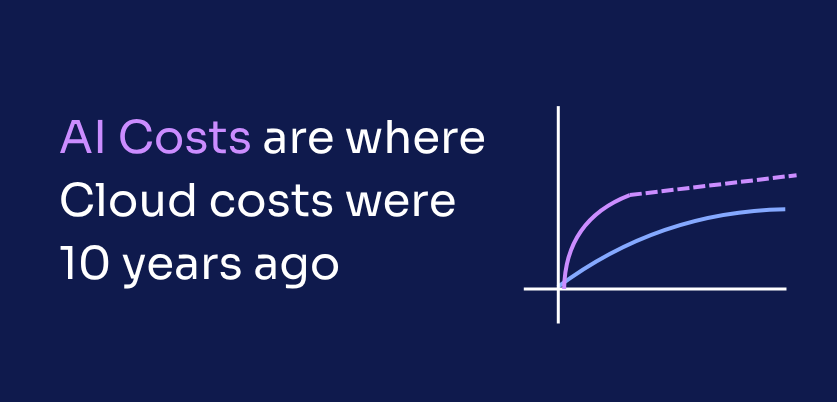
AI spend is following the exact path cloud costs took ten years ago, only steeper. The lesson from the last cycle is already paid for. Apply it early.
We paid for this lesson once. No need to pay for it twice.
Ten years ago, the cloud bill caught almost everyone off guard.
Not because anyone did anything wrong. Because the model changed faster than the surrounding controls.
Think about how tech spend used to work. You bought servers. You approved a budget. Costs moved at the speed of a purchase order. Slow, but predictable. You always knew roughly what next quarter looked like.
Then the cloud arrived and handed every engineer a tap. Spin up capacity in minutes. No purchase order. No sign-off. Brilliant for speed. Less brilliant for the person who has to explain the invoice.
Here is what actually happened. Spending decisions moved out of finance and into hundreds of small technical choices, made daily, by people who never saw the total.
The result was the same story everywhere. The bill crept up, month after month. Finance asked why. And nobody could give a straight answer, because the spending was scattered across thousands of decisions, and no single person could see the whole picture.
Out of that mess, a whole discipline appeared. We call it FinOps. Visibility, ownership, forecasting and accountability, bolted onto how engineering works.
It worked. It is standard practice now. But notice the timing. It showed up years after the problem did. And those years were expensive.
The same film is starting again. This time in fast-forward.
AI spend has the same shape. Only steeper.
Like cloud, it is priced on usage. Every prompt, every document processed, every automated task carries a cost.
Like cloud, adoption is decentralised. Right now, teams across your org are wiring AI into things. Often without anyone central knowing. The barrier to starting is basically zero.
And like the cloud, it stays invisible until the invoice lands. AI spend scales with activity, not headcount. A pilot that looks like pocket change can grow tenfold once the whole company leans on it. Typically, with no mechanism in place to see it coming.
There is one difference, and it is the one worth paying attention to. AI costs tend to compound. The more useful the system, the more it gets used. The more it gets used, the more it costs. Success and spending climb together.
Read that line again. Your best AI feature is also your fastest-growing cost.
The lesson from the last cycle
Here is the part worth stealing.
The organisations that handled cloud costs well were not the ones that spent the least. They were the ones who could see their spending, explain it, and make deliberate calls about it.
The ones that struggled? They waited. They let it become a board-level problem first, then scrambled for discipline after the fact.
That is the whole game. Cost is not a reporting problem you tidy up later. It is an engineering decision you make on the way in.
The good news, for once
With AI, the choice is available early.
You do not have to invent anything. The governance, the ownership models, and the hard-won lessons already exist. The cloud era paid for them.
So the only real question for anyone rolling out AI at scale is this. Do you apply those lessons now, while the spend is still small and the stakes are low? Or do you repeat the cycle and pay for the same education twice?
Ten years ago, almost nobody saw the cloud bill coming.
This time, you can.
At Koritsu we treat cloud and AI costs as an engineering problem, not a reporting one. If your cloud bill has started showing up in conversations with finance, that is usually the signal. Worth flagging that the AI version of this is already taking shape in most environments.
Start with a Savings Opportunity report